
CNC Router Bit Types Chart: Every Main Type, What It Does, and When to Use It
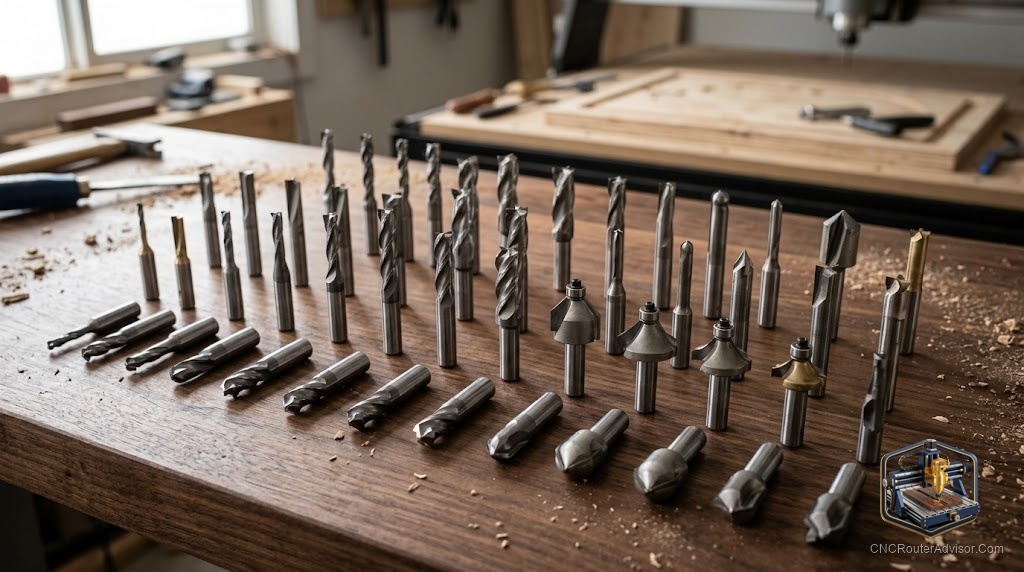
A quick-reference chart of CNC router bit types is one of those resources that pays back the time to learn it many times over, because every time you set up a new job the question of which bit to use comes up, and having the types and their uses mapped clearly in your head (or posted on the wall) removes a decision that should not take long. This guide serves as that reference: every main bit type, its geometry, its primary use, and the conditions that favor it or rule it out.
CNC router bit types are the categories of router bits distinguished by cutting geometry, each suited to specific operations: profiling, pocketing, engraving, lettering, 3D carving, surfacing, drilling, and specialty cuts. Knowing the type and its geometry tells you what the bit can physically do and what it cannot, which is the only information you need to choose the right one for any job.
Here is the direct reference: the six main bit types for most CNC wood and general work are up-cut spiral, down-cut spiral, compression bit, V-groove bit, ball-nose bit, and surfacing bit, with specialty types for specific applications. Each is described below with its geometry, primary use, and conditions that favor or exclude it.
Up-cut spiral
Geometry: Flutes spiral upward, pulling chips up and out of the cut. Primary use: Profiling, through-cuts, slotting, and any operation where chip clearance is the priority. Favor: Deep slots, through-cuts in thick material, operations where the bottom face quality matters more than the top. Exclude: Operations where a clean top surface is required; the upward pull frays the top veneer on plywood and veneer stock.
Down-cut spiral
Geometry: Flutes spiral downward, pressing chips down and the top surface into the material. Primary use: Pocketing, profiling where a clean top surface is needed, signs, and furniture panels. Favor: Plywood, MDF, and finished wood where the top face must be clean. Exclude: Very deep slots without chip clearance provision; down-cut bits pack chips and need shallower passes.
Compression bit
Geometry: Up-cut geometry at the bottom, down-cut geometry at the top of the flute, designed to clean both faces in a through-cut. Primary use: Full through-cuts in plywood and veneered panels where both top and bottom faces must be clean. Favor: Plywood production, cabinet door cuts, and any through-cut where face quality on both sides matters. Exclude: Shallow passes that do not engage both cutting geometries; a compression bit needs enough depth to bring both sections into contact.
V-groove bit
Geometry: Tapered, V-shaped cutting profile in various angles (30, 45, 60, 90 degrees common). Primary use: Lettering, sign carving, V-carving, decorative grooves, and engraving. Favor: Any job using a V-carving toolpath in CAM software; crisp text and decorative lettering. Exclude: Flat-bottomed pockets; the V geometry produces a tapered groove, not a flat floor.
Ball-nose bit
Geometry: Rounded, hemisphere-shaped cutting tip. Primary use: 3D relief carving, contour passes, and smooth curved surfaces. Favor: Any job needing smooth 3D surfaces; tight stepover passes for high-resolution finishes. Exclude: Flat-bottomed pockets and profiles where a flat floor is needed; the round tip leaves a curved bottom.
Surfacing (fly cutter / spoilboard cutter)
Geometry: Large-diameter flat-bottom cutter with multiple inserts. Primary use: Leveling spoilboards, surfacing large flat areas, and face-milling panels. Favor: Spoilboard resurfacing and face passes on wide stock where speed matters more than fine finish. Exclude: Detail work, pockets, and profiles; these bits clear large areas fast but are not for fine cutting.
Specialty types
Beyond the six main types: straight (single-flute) bits for clean slots in soft material; tapered ball-nose bits for fine 3D detail and relief edges; O-flute (single-flute) bits for aluminum and plastics; dovetail bits for joinery; and keyhole bits for keyhole slots and hanging hardware.
For a focused look at the best bits for wood work, see our guide to router bits CNC.
Final verdict
Knowing CNC router bit types by geometry and primary use is the foundation of every job setup decision. Up-cut for chip clearance, down-cut for clean top surfaces, compression for clean both-face through-cuts, V-groove for lettering, ball-nose for 3D, and surfacing for large flat areas cover the vast majority of CNC work. Add specialty types as your work demands them. The chart is not complicated; the decision loop is short once the types are clear.
FAQ
What are the main types of CNC router bits? Up-cut spiral, down-cut spiral, compression, V-groove, ball-nose, and surfacing bits cover most CNC work. Specialty types like O-flute, tapered ball-nose, and dovetail bits serve specific applications.
When should I use a compression bit instead of a down-cut? When both the top and bottom face of a through-cut must be clean, as in plywood panel cutting. A compression bit cleans both faces in a single pass; a down-cut only cleans the top.
What angle V-groove bit should I use? Depends on the lettering size and style. Narrower angles (30-45 degrees) produce finer, deeper grooves for small text. Wider angles (60-90 degrees) produce wider, shallower grooves for larger text and decorative work.
Can I use a ball-nose bit for flat pockets? Technically yes, but the round tip leaves a curved floor with a scallop pattern. For flat-bottomed pockets, use a spiral (up or down-cut) or straight bit.
What is a surfacing bit used for? Leveling spoilboards and face-milling large flat areas quickly. It is a maintenance and preparation tool rather than a precision cutting bit.
What is an O-flute bit? A single-flute bit with maximum chip clearance geometry, designed for plastics and aluminum where chip packing is the primary failure mode. Not suited to wood where multi-flute bits give better finish.
References
- Amana Tool, bit type reference documentation: https://www.amanatool.com
- Onsrud, router bit geometry and selection: https://www.onsrud.com
- Carbide 3D, bit type and use reference: https://carbide3d.com