
CNC Router Bit Set: How to Build a Focused, Capable Set Without Overbuying
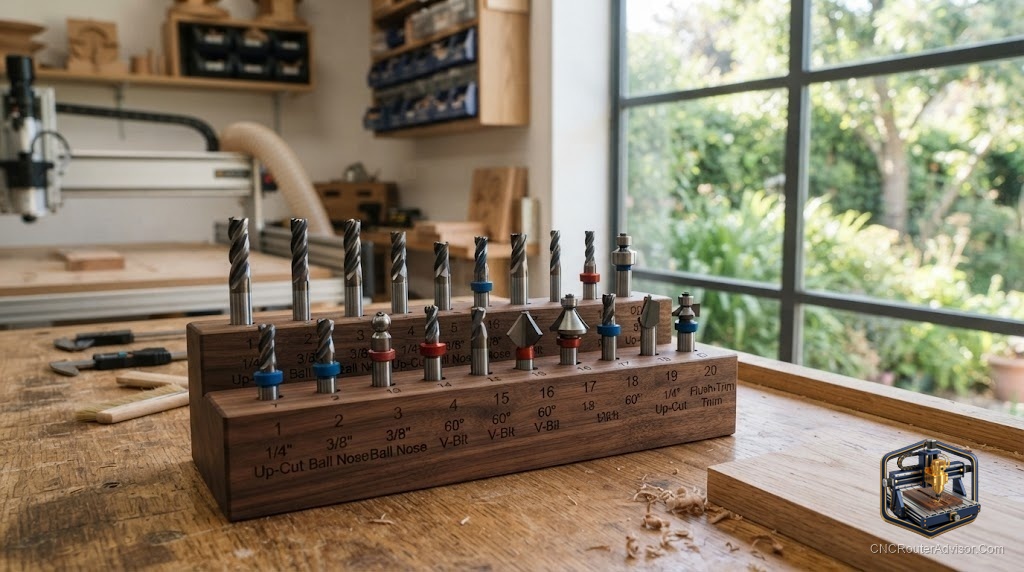
A CNC router bit set sounds straightforward until you are looking at a listing for 100 bits for a very low cost and wondering whether that or a focused set of ten quality bits is the smarter starting point. The answer is almost always the focused quality set, because a hundred cheap bits cannot collectively match the performance of ten quality bits matched to your actual work. Understanding what a capable bit set includes and what to look for at each type helps you build the set that does your actual work rather than the one that looks impressive in a drawer.
A CNC router bit set is a matched collection of router bits covering multiple types and sizes to handle the main cut operations in a CNC workflow, typically including spiral up-cut or down-cut bits, V-groove bits, and sometimes ball-nose bits, selected to cover signs, profiles, lettering, and 3D work from a single purchase.
Here is the direct guidance: a practical starting bit set needs three to four bit types to cover most CNC wood work, spiral cutting bits for profiling and pocketing, V-groove bits for lettering, and ball-nose for 3D work, and quality matters more than quantity. Verified sets and individual picks for each type are below. The sections cover what to include, what to look for, and the quantity trap to avoid.
The core types every bit set needs
A capable CNC router bit set starts with these three types. First, spiral bits for profiling, pocketing, and through-cuts: down-cut for clean top surfaces, up-cut for chip clearance. The SpeTool 5-piece down-cut spiral bits with a 1/4 inch shank are a solid starting set for this category. Second, V-groove bits for lettering, engraving, and signmaking: the Genmitsu 10-piece V-groove set with a 1/8 inch shank covers the useful angle range in a single purchase. Third, a general purpose set from a quality manufacturer for breadth: the Freud 8-piece CNC general purpose set (87-208) provides a range of types from a tooling brand with a documented track record.
What to look for in a bit set
Three things matter in evaluating a set over buying individual bits. First, shank consistency: all bits in the set should use the same shank diameter so you can use them all without changing collets (or at least use them in the same two collet sizes you have). Second, solid carbide versus carbide-tipped: for small bits especially, solid carbide deflects less and holds an edge longer than carbide-tipped alternatives. Third, geometry coverage: the set should include multiple cut types, not just one type in many sizes, since variety of type serves most workflows better than variety of size.
The quantity trap
A 100-piece bit set at a low price sounds like value until you realize that most of those bits are duplicates of sizes you rarely use, made from lower-quality steel with minimal coating, and that the few bits you actually rely on will need replacing quickly because they dull fast. A focused set of 15 to 20 quality carbide bits in the types you actually use consistently outperforms the large, cheap set in every practical metric: cut quality, edge life, and the simple reliability of knowing your bit will finish the job it started.
For the full type reference and what each bit type does, see our guide to the best CNC router bits for wood.
Final verdict
A CNC router bit set is most useful when it covers the three or four bit types your actual work requires, in quality solid carbide, with shank diameters matched to your collets. Down-cut spirals, V-groove bits, and a general purpose set from a quality brand is a complete starting collection. Resist the quantity trap: 20 quality bits do far more work than 100 cheap ones, and knowing which bit to reach for and trusting that it will perform is itself a significant part of the value.
FAQ
What bits should a basic CNC router set include? Down-cut or up-cut spiral bits for profiling and pocketing, V-groove bits for lettering, and optionally ball-nose bits for 3D work. These three types cover most CNC wood work.
Is a 100-piece bit set worth it? Rarely. Large cheap sets are mostly sizes you rarely use, made from lower-quality material. A focused set of 15 to 20 quality carbide bits in the types you actually use consistently outperforms it.
What shank size should I choose for a bit set? Match all bits to your machine’s collet size: 1/8 inch for compact machines with an ER11 collet, 1/4 inch for larger machines. Buying a mix of shank sizes requires multiple collets or adapters.
What is solid carbide and why does it matter? Solid carbide bits are machined from a single carbide blank, resisting deflection and holding a sharp edge longer than carbide-tipped alternatives, especially at small diameters.
Does a bit set need to all be from the same brand? No, but shank consistency and geometry coverage matter more than brand consistency. A set that covers the right types in quality carbide serves you better than a set from one brand that only covers one type.
How many bits do I actually need to start? Fifteen to twenty quality bits covering three or four types is a practical starting set that handles most CNC work without the excess of a large cheap collection.
References
- Amana Tool, bit type and set selection reference: https://www.amanatool.com
- SainSmart Genmitsu, bit set and collet guidance: https://www.sainsmart.com/blogs/news
- Carbide 3D, bit selection for beginners: https://carbide3d.com