
Handheld CNC Wood Router Guide: Tooling, Speeds, Workholding, and Finish Quality
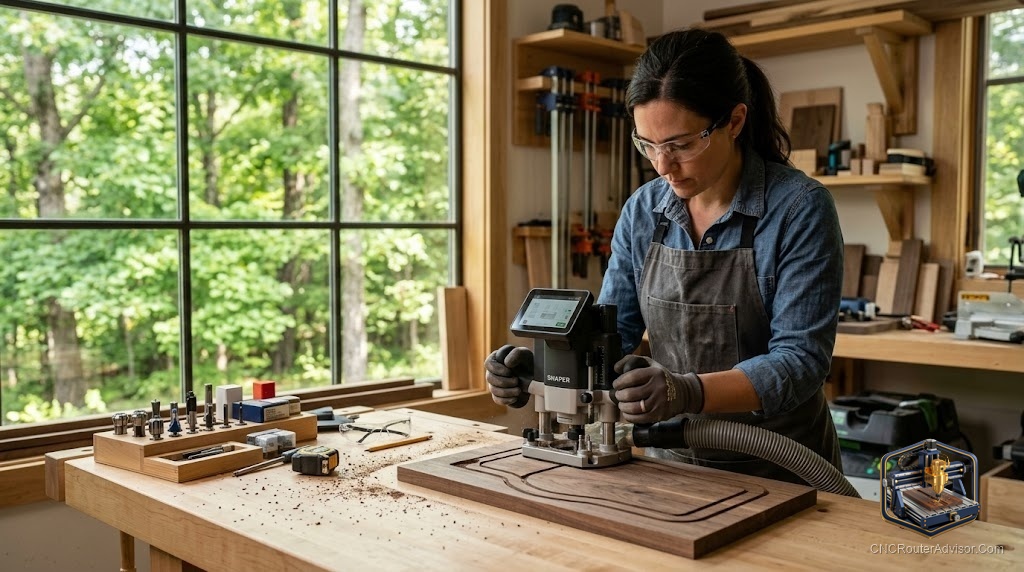
The phrase “handheld CNC” sounds like a contradiction, and for good reason: a CNC machine is defined by a computer controlling motion, while a handheld tool is guided by your arm. What people usually mean by a handheld CNC wood router is one of two things, and sorting out which one you want matters, because they lead to completely different tools and completely different results. Get the definition straight first, and the buying decision becomes much clearer.
A handheld CNC wood router refers either to a computer-guided handheld tool, where onboard electronics correct your movements to follow a design, or, more loosely, to a compact trim router used by hand in woodworking. The genuinely “CNC” version uses position sensing and a moving bit to keep cuts on the design as you guide the tool by hand, blending human movement with digital precision. Knowing which meaning applies decides the tooling, technique, and results you should expect.
Short answer: a true handheld CNC wood router is a hand-guided tool with onboard smarts that correct the bit’s position to follow a digital design, giving portability and large-format reach without a big machine. It suits signs, large panels, and on-site work, with results depending on the system’s accuracy and your steadiness. If you need repeatable production or fine 3D detail, a fixed-gantry CNC router is the better tool. Confirm which “handheld” you actually want first.
Two meanings of “handheld CNC”
- A computer-guided handheld tool. You move the tool roughly along the design while onboard sensing and a small motor adjust the bit to stay precisely on the path. This is the true “CNC” sense: human motion plus digital correction.
- A plain handheld trim router. A compact router guided entirely by hand, not computer-controlled. Sometimes called this loosely, but it has no CNC element.
Decide which you mean, since only the first offers digital precision, and the two lead to very different purchases.
Where a handheld CNC shines
The guided-handheld approach has real strengths:
- Portability. You bring the tool to the work instead of fitting the work into a machine.
- Large-format reach. You can cut designs larger than any fixed bed by moving across the material.
- On-site work. Useful for large signs, panels, and installation work where a big machine cannot go.
- Lower footprint. No large gantry machine taking over the shop.
Its limits
The same approach has honest drawbacks:
- Depends on your movement. You still guide the tool, so pace and steadiness affect the result.
- Less suited to fine 3D. Detailed relief and tight repeatability favor a fixed CNC.
- Throughput. Hand-guided work is slower for repeated production than an automated machine.
Tooling and speeds
Tooling follows normal wood-routing logic: straight and upcut spiral bits for cutting and clearing, V-bits for lettering, and ball-nose bits for contoured detail, all in carbide for edge life. Run feeds and speeds appropriate to the bit and material so chips clear rather than the bit rubbing and burning. Because you supply the feed motion in a guided-handheld system, move at a steady pace that matches the intended chip load, and let the tool’s correction keep the path accurate.
Workholding and dust
Even though the tool moves, the material must not. Clamp the workpiece firmly to a bench or surface so it cannot shift, since movement ruins accuracy and finish. Manage dust with a shop vacuum or dust extraction, as wood produces heavy dust and clear sightlines matter when guiding by hand.
Finish quality
Finish depends on the system’s accuracy, sharp tooling, correct speeds, and your steadiness. Sharp carbide bits, a proper chip load, and a smooth, even guiding pace give clean edges. Fuzz or burning usually means a dull bit or wrong speeds; wandering lines mean moving too fast for the correction system or inadequate workholding. Test on scrap to find a comfortable pace before committing to a real piece.
Who should choose it, and who should skip
Choose a handheld CNC wood router if you value portability and large-format reach, cut signs and big panels, or work on-site where a fixed machine cannot go. Skip it if you need high-volume repeatable production or fine 3D relief, where a fixed-gantry CNC router is more accurate and faster, and skip it entirely if you actually just want a plain trim router, which is a simpler, cheaper tool with no CNC element.
The bottom line
A handheld CNC wood router blends human guidance with digital correction, trading some precision and speed for portability and large-format reach that no fixed bed can match. It is a strong choice for signs, big panels, and on-site work, with results resting on the system’s accuracy, sharp tooling, correct speeds, firm workholding, and a steady hand. If you need repeatable production or detailed 3D, a fixed CNC serves better. Start by confirming which “handheld” you mean, and the right tool becomes obvious.
FAQ
What is a handheld CNC wood router? Either a hand-guided tool with onboard sensing that corrects the bit to follow a digital design, or, loosely, a plain handheld trim router with no CNC element.
Is a handheld CNC as accurate as a fixed machine? It can be accurate for many cuts, but fine 3D relief and high repeatability favor a fixed-gantry CNC. Results also depend on your guiding steadiness.
What is a handheld CNC good for? Portability, large-format work, and on-site jobs, cutting big signs and panels or working where a large fixed machine cannot go.
What tooling does it use? Standard wood bits: straight and upcut spirals for cutting, V-bits for lettering, and ball-nose bits for detail, all in carbide for edge life.
How do I hold the work? Clamp the material firmly to a bench so it cannot move, since any shift ruins accuracy and finish even though the tool itself is hand-guided.
Why are my cuts fuzzy or wandering? Fuzz or burning usually means a dull bit or wrong speeds; wandering lines mean moving too fast for the correction system or weak workholding.
Should I get a handheld CNC or a fixed one? Choose handheld for portability and large-format reach; choose a fixed CNC for repeatable production and fine 3D detail. Match the tool to your work.
References
- CNCRouterInfo, how to choose a CNC router: https://cncrouterinfo.com/guides/how-to-choose-a-cnc-router/
- BubbleRelief, CNC router projects for beginners: https://bubblerelief.com/cnc-router-projects-for-beginners/