
CNC Router Bits Guide: Types, Uses, Sizes, and Selection Tips
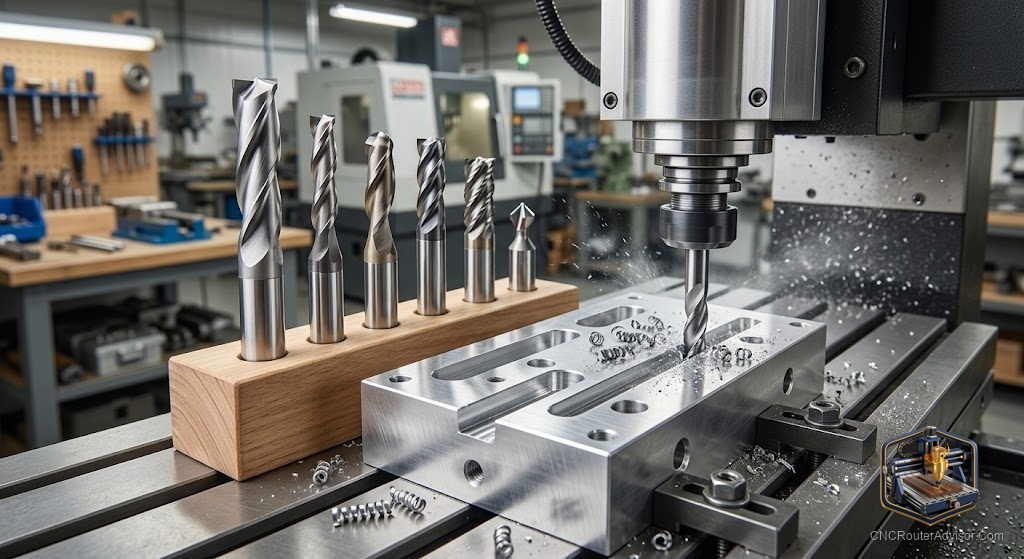
The sign came out with a fuzzy top edge, torn fibers along the pocket walls, and a slight burn on the corners. The wood was fine. The toolpath was fine. The problem was a downcut bit in a situation that needed an upcut, running at a chip load so thin the carbide was rubbing instead of cutting. One wrong bit choice added an hour of sanding to a twenty-minute cut job.
CNC router bits are purpose-built rotary cutting tools that mount in a CNC router’s collet and remove material along a computer-controlled path. Unlike handheld router bits, they are designed for continuous multi-pass cutting at consistent feeds and speeds, which means geometry, carbide grade, flute count, and coating all matter in ways that casual manual routing rarely demands.
For most CNC wood routing, a 1/4-inch upcut spiral end mill handles profile cuts and deep pockets, a 60 or 90-degree V-bit handles lettering and decorative engraving, and a compression bit handles plywood and laminated panels where top and bottom face quality both matter. Those three bits get you through 80 percent of hobbyist projects.
The Core Bit Types and What Each One Does
Upcut Spiral End Mills: Your Workhorse
An upcut spiral end mill has flutes that spiral upward from tip to shank, pulling chips up and out of the cut. This keeps the cut path clear and cool, which is why upcut bits are the default choice for deep pockets, profiling, and through-cuts in solid wood and MDF.
The trade-off: the upward chip ejection also pulls the top fiber of the wood upward as the bit exits, leaving a slightly torn or fuzzy top edge. In painted or primed work, that’s sanded away. In show-face work — the top of a cutting board, the face of a sign — it can be a problem.
Use upcut bits for: pocketing operations in solid wood and MDF, through-cuts where the bottom face isn’t critical, slotting and profiling in material 3/4 inch or thicker.
Downcut Spiral End Mills: Clean Tops, Clogged Chips
Downcut bits spiral in the opposite direction, pressing chips downward toward the cut floor. The top edge of the workpiece stays crisp and clean because fibers are pressed into the material rather than lifted away.
The problem: chips get pushed into the cut path instead of evacuated. In deep pockets, heat builds and the bit can pack up with material. Downcut bits work best in shallow passes (no deeper than the bit’s diameter per pass) and in applications where top-face quality is the priority.
Use downcut bits for: shallow pockets where a clean top edge matters, surface engraving in hardwood, and flush-trim operations on veneered panels.
Compression End Mills: The Plywood Standard
A compression bit combines an upcut geometry at the tip with a downcut geometry closer to the shank. The upcut section presses upward on the bottom face; the downcut section presses downward on the top face. Both surfaces come out clean.
There is one important rule: your first pass must go deep enough that the upcut portion of the bit is fully below the top surface of the material. If you take a shallow first pass, only the downcut section is cutting the visible face, and you get the same torn bottom edge you’d get from a pure downcut bit. For a typical 1/4-inch compression bit, that means a first pass of at least 3/16 inch.
Use compression bits for: through-cuts in plywood, melamine, laminated MDF, and any sheet good where both faces will be visible in the finished piece.
V-Bits and V-Groove Bits: Letters, Logos, and Detail Work
V-bits have a pointed tip and a V-shaped cutting profile. As the bit plunges deeper, the cut gets wider. CNC software uses this relationship to produce V-carve toolpaths where shallow cuts make thin strokes and deeper cuts widen strokes — perfectly mimicking the look of hand-carved lettering.
The angle of the V determines the look. A 60-degree V-bit produces sharper, narrower grooves for fine detail work and small text. A 90-degree V-bit produces wider, flatter grooves that look better on bold fonts and large lettering. A 30-degree bit makes very sharp, narrow lines useful for engraving small graphics.
V-bits are not designed for heavy material removal. Run them at the recommended RPM (typically 18,000 to 24,000 for carbide), keep the feed rate moderate, and never plunge straight down — always use a ramping entry to avoid snapping the tip.
Use V-bits for: lettering, logos, decorative engraving, house number plaques, and any project where you need varying-width grooves from a single pass.
Ball-Nose End Mills: 3D Relief and Smooth Surfaces
Ball-nose bits have a hemispherical tip and are the standard tool for 3D relief carving. As the bit steps over in parallel passes, the round tip sculpts smooth curved surfaces — wood portraits, topographic maps, decorative panel textures.
Step-over distance controls surface finish. A step-over of 10 percent of the bit’s diameter produces a smooth, near-invisible scallop pattern. A 30 percent step-over is faster but leaves visible ridges that require sanding. Most hobbyists use a larger roughing pass with a straight end mill, then switch to a ball-nose finish pass at 10 to 15 percent step-over.
Use ball-nose bits for: 3D relief carving, sculpted signs with dimensional lettering, topographic maps, and any work requiring smooth curved surfaces.
Surfacing Bits: Flattening Your Spoilboard
A surfacing bit (also called a fly cutter or surfacing router bit) has a large-diameter flat cutting geometry designed to skim thin passes across a surface. You use it to flatten your spoilboard when it develops low spots, and to face-mill rough slabs before cutting.
They are not for deep cuts — they remove 0.02 to 0.06 inch per pass and move fast across the surface. Run them at the low end of your spindle’s RPM range.
Single-Flute vs. Two-Flute: The Chip Evacuation Trade-Off
Single-flute end mills have one cutting edge and a large open flute channel. They are the standard choice for soft materials like MDF, foam, and softwood because the large chip pocket evacuates material quickly before it can re-cut and heat the bit. They run faster feed rates than two-flute bits of the same diameter.
Two-flute end mills have two cutting edges, which means more cuts per revolution and a smoother surface finish, but smaller chip pockets. In hardwood, they produce excellent results. In MDF and foam, they can pack up with fine dust if the feed rate isn’t high enough to clear chips between flute passes.
Carbide Grade and Why Bit Quality Actually Matters
Not all carbide is the same. CNC router bits are made from tungsten carbide powder sintered into a solid form, and the grain size of that carbide directly affects edge sharpness, heat resistance, and how long the bit stays sharp.
Micro-grain and sub-micrograin carbide (grain sizes below 1 micron) holds a sharper edge, stays sharper longer, and resists chipping better than coarser-grain carbide. This is what separates a budget end mill from a premium Amana Tool or Whiteside bit. Amana Tool uses sub-micrograin and micrograin carbide across their CNC line, with precise geometry and quality induction brazing for maximum bond strength between carbide and shank.
Carbide-tipped vs. solid carbide: Carbide-tipped bits have a steel body with carbide brazed onto the cutting edges. Solid carbide bits are made entirely from carbide and are stiffer, more precise, and better suited for high-RPM CNC use. For CNC routing, solid carbide is the standard.
Coatings (TiN, TiAlN, ZrN) extend tool life in specific materials. ZrN coatings reduce friction and built-up edge in aluminum and plastic. For straight wood cutting, uncoated premium carbide is usually the better value.
The honest answer on brands: Amana Tool is widely regarded as the premium option in the hobby and professional CNC community, with users reporting significantly longer tool life and better finish quality versus generic bits. Whiteside is considered an excellent mid-tier option at lower prices. Budget bits from no-name sources work for initial testing and rough work but dull faster, which costs you more in resharpenings and ruined pieces over time.
Collet Size, Shank Diameter, and Runout
Your CNC router accepts bits through a collet — a precision sleeve that grips the shank. Most hobby machines use ER11 collets (up to 1/4-inch shank) or ER16 collets (up to 3/8-inch shank). VFD spindles often use ER20 collets, which accept up to 1/2-inch shanks.
Always match the bit shank to the collet. Running a 1/4-inch shank bit in a 1/4-inch collet is correct. Running a 6mm bit in a 1/4-inch collet (which is 6.35mm) introduces runout and will eventually damage both the collet and the bit.
Tool runout is the amount the bit tip wobbles off-center as it spins. Even small amounts of runout (0.01mm or more) reduce effective chip load, cause vibration, and shorten tool life. A quality collet, kept clean of chips and resin, is as important as the bit itself. Replace collets when they show wear marks or if runout increases.
Tool deflection becomes a problem on long bits in deep cuts. A bit that sticks out 3 inches from the collet deflects far more than the same bit sticking out 1 inch. Keep bit stick-out as short as the job allows.
Understanding Chip Load: The Most Important Number in Feeds and Speeds
Chip load is the thickness of the material each flute removes per revolution. The formula is:
Feed Rate = RPM x Flute Count x Chip Load
If you know your target chip load, your RPM, and your flute count, you can calculate the right feed rate. For a 1/4-inch two-flute upcut end mill in soft wood at 18,000 RPM with a target chip load of 0.004 inches:
Feed Rate = 18,000 x 2 x 0.004 = 144 inches per minute
Too low a chip load means the bit is rubbing rather than cutting — heat builds up, the carbide dulls rapidly, and you get burning or glazing on the wood surface. Too high a chip load means the bit is taking too big a bite, which causes deflection, chatter, and eventually breakage.
As a starting point for hobby machines in soft wood: set RPM to the lower end of your spindle range (16,000 to 18,000), depth of cut to 50 percent of the bit’s diameter, and feed rate to 60 to 100 inches per minute for a 1/4-inch two-flute bit. Adjust from there based on what you hear and see.
Bit Selection by Material
Solid hardwood (oak, maple, walnut): Two-flute upcut spiral end mill for profiling and pockets. Downcut for show-face surfaces. V-bit for lettering. Compression bit for sheet hardwood panels. Keep chip load on the higher end to avoid burning.
Softwood (pine, cedar, poplar): Single or two-flute upcut end mill. Softer fibers tear more easily, so sharp carbide matters more than it does in hardwoods.
Plywood and MDF: Compression end mill for through-cuts. Downcut for pocketing in MDF where top-edge quality matters. Upcut for deep profiling. MDF is abrasive and dulls bits faster than solid wood — budget for more frequent bit replacement.
Acrylic and HDPE plastics: Single-flute O-flute end mill designed for plastics. Acrylic melts rather than chips if the cut generates heat, so high feed rates and moderate RPM are critical for chip evacuation.
Aluminum: Single-flute upcut carbide end mill with a ZrN coating if possible. Shallow depth of cut, moderate RPM (12,000 to 18,000), and high feed rate to evacuate chips before they re-cut and weld to the bit.
Three Bits to Buy First
- 1/4-inch two-flute upcut spiral end mill — handles profiling, pocketing, and through-cuts in wood and MDF. Your single most-used bit.
- 60-degree V-bit — covers lettering, logos, and engraving on signs and plaques.
- 1/4-inch compression end mill — for plywood, laminated panels, and any double-faced sheet good.
Add a ball-nose for 3D work and a surfacing bit for spoilboard flattening when you’re ready. Everything else is project-specific.
Conclusion
The bit you choose does as much work as the machine holding it. A sharp, correctly specified carbide bit at the right chip load produces clean edges, cool cuts, and long tool life. A cheap bit at the wrong feed rate burns your wood, tears fibers, and breaks prematurely.
Four takeaways:
- Upcut for chip evacuation, downcut for top-face quality, compression for plywood’s both-face problem.
- V-bits are not just for lettering — angle choice shapes the entire look of a carve.
- Chip load is the number that governs everything: too low burns, too high breaks.
- Carbide grade separates budget bits from premium brands like Amana and Whiteside — the difference shows up in finish quality and how many pieces you cut before sharpening.
FAQ
What are CNC router bits made of? Most CNC router bits are solid carbide (tungsten carbide sintered with a cobalt binder) or carbide-tipped steel. Solid carbide is stiffer and sharper, making it the standard for CNC use where precision and RPM matter.
What is the difference between an upcut and a downcut bit? An upcut bit pulls chips upward and out of the cut, keeping things cool but leaving a slightly torn top edge. A downcut bit pushes chips downward for a clean top surface but can pack chips into deep pockets. Choose based on which face of your workpiece is the show face.
When should I use a compression bit? Use a compression bit any time you need both the top and bottom face of a cut to be clean — plywood cabinet sides, laminated panels, and melamine board are the main cases. Make sure your first pass is deep enough that the upcut tip section clears the top surface.
What is chip load and why does it matter? Chip load is the thickness of material each flute removes per revolution. Too little chip load causes rubbing, heat, and rapid dulling. Too much causes deflection and breakage. The right chip load for your bit, material, and machine is the core of feeds-and-speeds setup.
Are Amana Tool router bits worth the price? For production use and finish work, yes. Amana uses sub-micrograin carbide with precise geometry that holds its edge longer and produces cleaner cuts than budget bits. For occasional hobby use in soft wood, a mid-tier brand like Whiteside offers similar quality at lower cost. Cheap no-name bits are fine for test cuts and rough work.
What collet size do I need? Most hobby routers use 1/4-inch collets. VFD spindles often use ER16 or ER20 collets accepting up to 3/8 or 1/2-inch shanks. Match the bit shank exactly to the collet — never use reducers or run undersized shanks in oversized collets.
How do I know when a bit is dull? A dull bit produces burning on the wood surface, increased noise and vibration, fuzzy or torn edges in material that previously cut cleanly, and visibly darkened carbide edges. Replace or resharpen before dullness compounds into tool failure.
What is the best CNC router bit for MDF? A two-flute upcut spiral end mill with sharp carbide and a feed rate on the higher end (to clear abrasive MDF dust before it can re-cut). Compression bits work well for through-cuts in MDF-faced panels. MDF is abrasive, so plan for more frequent bit replacement than with solid wood.