
CNC Router for Wood: Machine Features, Tooling, and Buying Advice
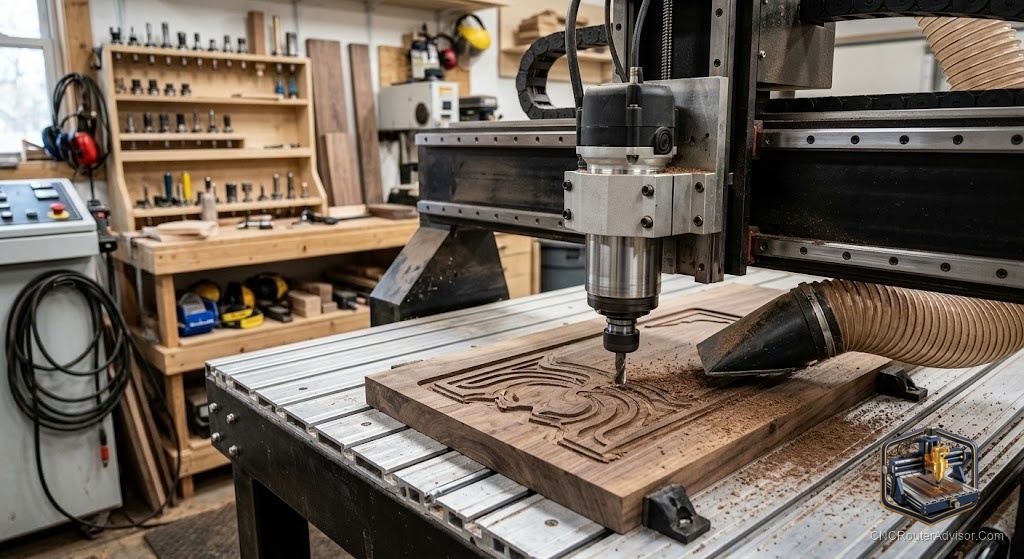
You’ve got a stack of oak cabinet doors to cut, a sign order due Friday, and a shop router that’s been giving you tear-out on every profile. The fix isn’t a sharper bit. It’s a cnc wood router machine that holds position to within a few thousandths, runs the same path 200 times without drifting, and leaves a surface you can finish straight off the tool. The question is which one actually delivers that, and which ones look good in spec sheets and disappoint in practice.
A CNC wood router is a computer-controlled cutting machine that moves a spinning bit along X, Y, and Z axes to cut, carve, or engrave wood from a digital file. You design in CAD or CAM software, generate G-code, and the machine executes it. Unlike a handheld router, every pass is identical. Unlike a laser, it produces actual 3D material removal.
Buy this if you regularly cut hardwood, sheet goods, or do repeat production work. A mid-range machine with a 2.2 kW spindle, ball screw drives, and linear rails will outperform a belt-drive hobby router on every material that matters: oak, maple, walnut, MDF, plywood, acrylic, HDPE.
What Does Spindle Power Actually Mean for Wood?
The spindle is where capacity lives. Power determines how aggressively you can cut and how deep you can go per pass without the machine bogging down.
A trim router (Makita RT0701C, DeWalt DWP611) running 1.25 hp is enough for pine, cedar, poplar, MDF, and foam. You’ll cut hardwoods like oak and maple with it, but you’re taking shallow passes at moderate feed rates. Push it too hard and the RPM drops, the bit rubs instead of shearing, and you get burn marks and fuzzy edges.
A 2.2 kW (roughly 3 hp) water-cooled or air-cooled spindle is a different tool. It maintains RPM under load, accepts collets for both 1/4” and 1/2” shank bits, and runs quietly enough for a home shop. For cabinet work in hardwood, sign making in thick MDF, or cutting HDPE and Delrin for jigs, a proper spindle earns its cost back in bit life and surface quality alone.
A VFD (variable frequency drive) paired with a spindle lets you dial RPM precisely rather than guessing at a numbered dial. For wood that matters more than it sounds: running 18,000 RPM with a 1/4” upcut spiral in MDF gives a clean chip load, while running 24,000 in the same cut produces dust and heat.
Work Area: Match the Machine to Your Sheet Size
Here’s where buyers go wrong. They buy a 24” x 24” machine, then spend a year wishing they could run half-sheets of plywood.
If your work involves sheet goods — cabinet parts, sign blanks, flat furniture panels — you want at least a 24” x 48” cutting area. A full 4x8 format (1325 machine, meaning roughly 1300mm x 2500mm work area) processes a full sheet of plywood, MDF, or HDPE in one setup. The 1325 woodworking CNC routers are the industrial standard at this size, common in small cabinet shops.
For desk-sized hobbyist work — jewelry boxes, inlay work, small carvings — a 12” x 24” or 24” x 24” footprint may be all you need. But be honest about where you’re going with the machine two years from now.
Z-axis clearance often gets ignored. Most desktop machines offer 3” to 4” of Z travel. If you plan to cut 3D carvings into thick stock, bowl blanks, or furniture parts that stand off a spoilboard, you need at least 5” to 6” of Z clearance or you’ll hit the gantry mid-carve.
Frame Rigidity and Motion System: Where Cheap Machines Fall Apart
You can have a powerful spindle bolted to a flimsy aluminum extrusion frame and still get terrible results. Rigidity determines whether the tool deflects under cutting forces, and deflection shows up as dimensional error, chatter marks, and premature bit wear.
Timing belt drives are common on entry-level machines like older Shapeoko and X-Carve models. They work fine for foam, thin MDF, and light carving. In hardwood or at higher feeds, belt stretch causes the axis to lag, and you lose accuracy at corners.
Lead screws with anti-backlash nuts are a step up. They’re stiffer than belts, handle heavier cuts, and are the default on mid-tier machines.
Ball screws are what you want for production work or hardwood cutting. They’re preloaded to eliminate backlash, handle bidirectional loads cleanly, and hold position under load. Ball screws eliminate the stretch and positional drift you get from belts in harder materials.
Linear rails over V-wheel carriages similarly reduce play in the axes. V-wheels wear over time and introduce slop. Supported linear rails stay consistent.
A steel welded frame beats a bolted aluminum extrusion frame in rigidity. For wood, aluminum extrusion is often adequate. For acrylic, HDPE, carbon fiber, or fiberglass, steel is the better long-term choice.
Tooling: What to Run in Each Material
The bit determines surface quality as much as the machine does.
Softwoods (pine, cedar): A 1/4” two-flute upcut spiral is the workhorse. Chip evacuation is excellent in soft, open-grained woods. Run it at 18,000 RPM with chip loads around 0.011” to 0.013” per tooth.
Hardwoods (oak, maple, walnut): Drop to 0.009” to 0.011” chip load per tooth on a 1/4” two-flute bit. Walnut machines beautifully. Hard maple requires more conservative feeds and a sharp bit — dull bits in maple produce fuzz and heat fast.
MDF and plywood: Compression spirals shine here. MDF is dense, abrasive, and dusty. A compression spiral (upcut geometry at tip, downcut at top) gives clean faces on both surfaces of plywood and reduces delamination.
Acrylic: Single-flute O-flute bits specifically designed for plastics. High feed rate, moderate RPM (around 16,000 to 18,000), and chip evacuation or air blast to clear swarf and prevent re-melting. A two-flute bit in acrylic will pack chips and weld them back to the cut edge.
HDPE and Delrin: O-flute again. HDPE is forgiving; Delrin is harder and cleaner-cutting. Both benefit from sharp tooling and good chip clearance.
Carbon fiber and fiberglass: Down-cut spiral or compression spiral, dust collection mandatory. Both materials are abrasive and destroy standard carbide bits faster than any wood. Wear a respirator — the dust is a serious health hazard.
Dust Collection: Not Optional
MDF and hardwood routing produces fine airborne particles that are a respiratory hazard. A chip evacuation port on the router or spindle mount connected to a shop vacuum or dust collector is the minimum. On a full 4x8 sheet machine cutting MDF all day, a proper 2” to 4” dust collection port with a cyclone separator will save your lungs and your shop.
Some machines include dust shoe assemblies that track with the spindle. These capture chips at the source and make a real difference in air quality. Budget for this if it’s not included.
Software and Controller: The Path from File to Cut
Every CNC wood router machine needs a CAM program to turn your design into G-code, and a controller to run it.
GRBL is the open-source firmware running most hobby and prosumer machines. It’s free, well-documented, and connects to software like Carbide Motion, OpenBuilds Control, or Universal G-Code Sender.
Mach3/Mach4 is common on mid-tier and industrial machines, especially imported 1325-format routers. More capable than GRBL, supports more axes and macros, requires a Windows machine to run.
For CAM, Carbide Create is free and paired to Shapeoko machines. Vectric VCarve Desktop or Pro is the standard for woodworking shops — its toolpath generation for signs, inlay, and 3D carving is well-tested. Fusion 360 handles more complex 3D work and is free for personal use.
What to Buy and What to Skip
Buy if you need repeat accuracy on hardwood or sheet goods, plan to do production work, or cut anything beyond pine and MDF regularly. A machine with a proper spindle, ball screw drives, and linear rails is a tool you’ll outgrow upward — more materials, more complexity — rather than sideways into frustration.
Skip the cheapest 3018-format machines for woodworking. They’re fine for engraving and thin acrylic, but their tiny work area, low-power spindles, and flex-prone frames make real wood routing slow and inconsistent.
The honest verdict: For a garage or small production shop, a machine in the 24” x 48” range with a 2.2 kW spindle and ball screws hits the right balance of capability and cost. For full sheet cabinet work, the 1325 format is the professional standard.
Conclusion
The right cnc wood router machine matches your actual material list, not your aspirational one. Four things to remember:
- Spindle power over trim router if you cut hardwood regularly.
- Ball screws and linear rails over belts and V-wheels for dimensional accuracy.
- Match work area to your sheet size before you buy.
- Budget for dust collection as part of the machine cost, not an afterthought.
FAQ
What materials can a CNC wood router cut? Most wood CNC routers cut softwoods, hardwoods, plywood, MDF, particleboard, foam, and many plastics like acrylic, HDPE, and Delrin. Machines with a rigid frame and a proper spindle can also cut carbon fiber, fiberglass, and ABS, though these materials accelerate bit wear and require good dust collection.
How much spindle power do I need for hardwood? For occasional hardwood cutting in oak, maple, or walnut, a 1.5 kW spindle is workable with conservative passes. For production use or thick stock, a 2.2 kW spindle is the practical minimum. Trim routers under 1 hp will struggle with dense hardwoods and produce poor surface quality.
What is chip load and why does it matter? Chip load is the thickness of material each cutting edge removes per revolution. Too low and the bit rubs, generating heat that burns wood and dulls the bit. Too high and the bit deflects or breaks. For a 1/4” two-flute bit in hardwood, target 0.009” to 0.011” chip load per tooth.
Do I need a 4x8 machine to cut full sheets? Yes, if you want to cut a full sheet of plywood or MDF in one setup without repositioning. A 1325-format machine (roughly 4x8 foot cutting area) is the standard for cabinet and panel work. Smaller machines can cut full sheets with tiling techniques, but it adds setup time and introduces alignment risk.
What is the difference between a spindle and a router? A router is a handheld woodworking tool mounted to the CNC gantry. It’s less expensive and easier to replace, but RPM varies under load and precision collets are limited. A CNC spindle is purpose-built for machine use, maintains constant RPM under load via feedback control, and offers longer bearing life for production use.
What software do I need to run a CNC wood router? You need CAD software to design (or import) your part, CAM software to generate toolpaths and G-code, and controller software to send G-code to the machine. Common free options include Carbide Create (CAD/CAM), Fusion 360 (CAD/CAM), and OpenBuilds Control (controller). Vectric VCarve is the paid industry standard for woodworking shops.
Is MDF hard on router bits? Yes. MDF is dense and highly abrasive due to its resin-bonded fiber content. It dulls carbide bits faster than solid wood. Use compression spiral or single-flute bits designed for MDF, maintain proper chip loads, and replace bits before they get dull enough to burn rather than cut.
Can a CNC wood router cut aluminum? Some machines marketed for wood can cut aluminum at slow feeds, but it’s not their strength. A rigid steel-frame machine with a 2.2 kW spindle and ball screws can handle aluminum with proper tooling and conservative parameters. Belt-drive machines and machines with light aluminum extrusion frames will flex under the cutting forces aluminum demands.